Hip replacement · New York City
Direct anterior hip replacement
A hip replacement done through the front of the hip, with the patient lying on their back and the surgeon working between muscles.
Dr. H. John Cooper performs nearly all primary and the large majority of his revision hip replacements through the direct anterior approach, at Columbia University Irving Medical Center and NewYork-Presbyterian Hospital.
Midtown · Uptown · Westchester
The approach
Surgeons reach the hip joint from the back (posterior), the side (lateral) or the front (anterior). In the direct anterior approach the incision is on the front of the hip, typically about 8-12 cm long, and the surgeon works in the space between muscles instead of cutting through the large muscles at the back.
The worn ball and socket are replaced with an acetabular cup, a liner, a femoral head and a stem that sits inside the thigh bone.
Dr. Cooper was trained in this technique beginning in 2009 and has used the direct anterior approach for effectively 100% of his hip replacements since he began practice in 2012.
Who it suits
No single approach is best for every patient, but almost anyone who needs a hip replacement for arthritis can have it through the front when it is performed by a skilled and experienced hip surgeon. Body size, hip anatomy, and previous surgery near the hip all affect the complexity of the case, and surgeons may choose other approaches based on their experience.
The choice is made after an examination and review of your imaging, and it rests on your anatomy and your surgeon's experience with the technique. Dr. Cooper has performed more than 99% of his hip replacements through the direct anterior approach since 2012.
Before surgery
The office gives you written instructions and takes care of most of the preparation. The main steps are:
- Testing
- Blood tests and an EKG within 90 days of surgery, and occasionally other tests. It is easiest to have them done through the Columbia system. If you have them done elsewhere, the results need to reach the office at least a week before surgery, or surgery may be postponed.
- Medical clearance
- When it is needed, clearance comes from your primary care doctor, ideally two to four weeks before surgery. The Columbia anesthesia pre-operative clinic reviews your tests and clearance remotely.
- Education
- Read the "What to Expect" book you are given, and schedule a phone session with the joint replacement educator. It helps to include the person who will help you at home.
- Medications
- If you take a prescription blood thinner, a GLP-1 medication for diabetes or weight loss, or an SGLT-2 inhibitor, call the office for instructions. These medicines usually need to be stopped ahead of surgery, so please do not stop or continue them on your own.
- Eating and drinking
- Stop eating at least 8 hours before surgery. You are encouraged to keep drinking clear fluids, such as water, black coffee or tea, and sports drinks, until 2 hours before your scheduled time. This lowers the chance of dizziness or low blood pressure afterward.
- Download: Anterior hip replacement, what you need to know (PDF)
- Download: What to Expect: Total Hip Replacement, patient guide from Columbia Orthopedics and NewYork-Presbyterian (PDF)
- Download: Home exercises before hip or knee replacement, from the American Association of Hip and Knee Surgeons (PDF)
Recovery
Recovery varies with age, strength and health before surgery. Many patients are up and walking with support soon after surgery, and some studies show slightly quicker early recovery with the anterior approach than with others. This is how Dr. Cooper's patients are guided through it.
- Going home
- Patients go home either the same day as surgery or the next morning, depending on the patient and the plan made beforehand.
- Walking
- Walking starts right away and builds gradually. Most patients move from a walker to a cane to no support at all, with safety first.
- Exercise and therapy
- Dr. Cooper does not routinely prescribe outpatient physical therapy after hip replacement. The main exercise is walking. A few simple exercises (ankle pumps, thigh and buttock squeezes, and seated knee bending and straightening) help loosen the leg early. Hip-strengthening exercises such as straight leg raises, side leg raises and marching in place are avoided at first, because they can cause a temporary setback. If it is needed for safety at home, a therapist can visit.
- Swelling and bruising
- Both are normal. You may notice them around the hip, in the groin and down toward the knee or foot, and swelling usually builds for about five days before it improves. Ice for 20 minutes at a time, and elevate the leg for 20 to 30 minutes several times a day, with your toes above your nose.
- How the leg feels
- The leg may feel longer or shorter for the first few weeks. This settles as the muscles adjust, so please do not change your shoes or buy shoe lifts.
- Pain control
- A combination of medicines is used: acetaminophen, an anti-inflammatory medicine when it is safe for you, and a stronger medicine only for severe pain. Stop the stronger medicine as soon as the pain is tolerable. A bowel regimen is important while taking it.
- Blood clot prevention
- Most patients take aspirin for three weeks. Patients at higher risk are prescribed a blood thinner instead.
- Incision care
- The dressing is waterproof, so you can shower right away. Let the water run over the incision without scrubbing it, and keep it out of a bath or pool for three to four weeks. The outer bandage usually stays on until your first visit. Some patients are sent home with a suction dressing that stays on for about a week. Eating more protein and fewer sugary foods helps healing.
- Dental work
- Avoid elective dental visits for about three months after surgery. After that, most patients do not need antibiotics for dental work.
- Driving
- You may drive when you are off narcotic pain medicine and can move your foot comfortably between the gas and brake pedals. Most patients return to driving between 1 and 4 weeks after surgery.
- Return to work
- It is safe to return to work as soon as you wish, but return to work varies from patient to patient. The large majority return 6 to 8 weeks after surgery, and some return sooner if their function and job demands allow.
- First visit
- Your first follow-up visit is two to three weeks after surgery.
- When to call
- Call the office at (212) 305-6959 for a fever that stays above 101.5°F, wound drainage, increasing swelling or redness around the incision, pain that medicine does not control, inability to put weight on the leg, trouble tolerating your medicines, or swelling in the foot or calf with coolness or decreased feeling in the foot.
Recovery supplies
Some patients like to have recovery supplies at home that insurance does not usually cover. Recovery Shop is an independent third-party vendor that makes it simpler to order these items. Using it is optional, and many patients find the supplies helpful for their recovery.
Risks
Hip replacement carries risks with any approach, including infection, blood clots, fracture, a difference in leg length, dislocation, and wear or loosening of the implant over time. Points specific to the anterior approach:
- Numbness over the outer thigh from a small skin nerve near the incision.
- Wound healing problems in the skin crease at the front of the hip, which are more likely with a higher body mass index.
- Fracture of the thigh bone during surgery, which is one reason surgeon experience with the approach matters.
How Dr. Cooper works to prevent complications. Dr. Cooper has performed more than 4,000 hip replacements over his career. He plans each operation with care, from where the incision is placed to how gently the skin and soft tissue are handled, and uses specialized dressings. He has published on the risk factors for each of these complications, including fracture, dislocation, wound problems and infection; see the research. For most healthy patients, the combined risk of any major orthopedic complication after a primary total hip replacement is less than 1%.
Experience
- Surgical practice
- 15 years in New York City, at Columbia since 2017
- Teaching the technique
- Faculty, International Masters Anterior Course (IMACx): 2021 to 2026
Faculty, Anterior Hip Foundation annual meeting: 2024 and 2025
Best Video Technique, Anterior Hip Foundation, for a method to avoid damage to the tensor fascia lata during direct anterior hip replacement; Associate Editor, Direct Anterior Approach to Hip Reconstruction, Second Edition - Wound research
- Led a funded study of negative pressure wound dressings after direct anterior hip replacement; Research and Publications Committee, Anterior Hip Foundation
- Research
- 203 publications on hip and knee replacement, including 190 peer-reviewed papers and 13 book chapters
- Primary hips
- 292 total hip replacements in 2026, effectively all through the direct anterior approach
- Revision hips
- 38 revision or conversion hip replacements in 2026
- Published outcomes
-
Complication Pooled Rate Dislocation 1 / 1,022 0.10% Periprosthetic fracture requiring reoperation 0 / 1,022 0% Revision for mechanical failure 0 / 1,022 0% Deep infection (periprosthetic joint infection) 1 / 1,022 0.10% Superficial surgical site infection 14 / 540 2.6% Reoperation for any reason 2 / 1,022 0.20% Total patients 1,022 Sources:
Cooper et al., J Arthroplasty 2022 (n = 120)
Weiner et al., J Hip Surg 2023 (n = 420)
Weiner et al., Arthroplasty Today 2024 (n = 482)
The research
Dr. Cooper has published widely on the direct anterior approach. A selection of his papers and book chapters, most recent first:
- Iatrogenic tensor fascia lata damage during direct anterior approach total hip arthroplasty: a prospective study of frequency, timing, and risk factorsWoelfle et al. · Journal of Orthopaedic Surgery and Research · 2026
- Conversion total hip arthroplasty from a long cephalomedullary nail through the direct anterior approachBuchalter et al. · Arthroplasty Today · 2026
- Bikinis, tissue protectors, and the standard longitudinal incision: comparable wound complications and safety in DAA THACrockatt et al. · Arthroplasty Today · 2026
- Indications and outcomes of conversion total hip arthroplasty via the anterior and posterior approachesCrockatt et al. · Journal of Arthroplasty · 2025
- Aseptic revision total hip arthroplasty through an anterior approach: survivorship and risk factors for re-revisiondeMeireles et al. · Journal of Arthroplasty · 2024
- Incidence of lateral femoral cutaneous nerve dysfunction after total hip arthroplasty through the anterior-based muscle sparing surgical approachGorur et al. · Arthroplasty Today · 2024
- Anterior versus posterior approach for total hip arthroplasty in femoral neck fracturesMcCormick et al. · Arthroplasty Today · 2024
- Does lack of initial collar-calcar contact influence performance of collared cementless femoral stems?Weiner et al. · Arthroplasty Today · 2024
- The bikini approach is safe and effective for direct anterior approach THAWeiner et al. · Journal of Hip Surgery · 2023
- Muscle recovery after total hip arthroplasty: prospective MRI comparison of anterior and posterior approachesRobinson et al. · HIP International · 2023
- Randomized controlled trial of incisional negative pressure following high-risk direct anterior total hip arthroplastyCooper et al. · Journal of Arthroplasty · 2022
- Is the direct anterior approach to THA cost-effective? A Markov analysisBerg et al. · Clinical Orthopaedics and Related Research · 2022
- Risk factors for periprosthetic femoral fracture following non-cemented total hip arthroplasty through the direct anterior approachBerliner et al. · HSS Journal · 2022
- Iliopsoas impingement after direct anterior approach total hip arthroplasty: epidemiology, risk factors and treatment optionsBuller et al. · Journal of Arthroplasty · 2021
- Essential DAA technique: supine without traction (book chapter)Yang et al. · In: Direct Anterior Approach to Hip Reconstruction, Second Edition · SLACK Incorporated · 2021
- Effect of C-arm tilt on accuracy of intraoperative fluoroscopy in assessing acetabular component position during direct anterior approach for hip arthroplastyJang et al. · Journal of Orthopaedics · 2018
- Applied anatomy of the direct anterior approach for femoral mobilizationRodriguez et al. · JBJS Essential Surgical Techniques · 2017
- Risk factors for wound complications after direct anterior approach hip arthroplastyJahng et al. · Journal of Arthroplasty · 2016
- Direct anterior approach to THR: what it is and what it is notRodriguez et al. · Current Reviews in Musculoskeletal Medicine · 2013
Questions
Is the direct anterior approach better than other approaches?
No single approach is best for every patient. The majority of studies show slightly quicker early recovery, slightly less postoperative pain, and a clear lower risk of prosthetic dislocation with the anterior approach. However, long-term results are generally similar when the surgeon is experienced and proficient with the technique they use.
Does it avoid cutting muscle?
It works between muscles instead of splitting them, but "no muscle cut" overstates it. Some soft tissue, often one or more of the short external rotators, may be released when contracted to expose the joint safely.
How long is the incision, and where is it?
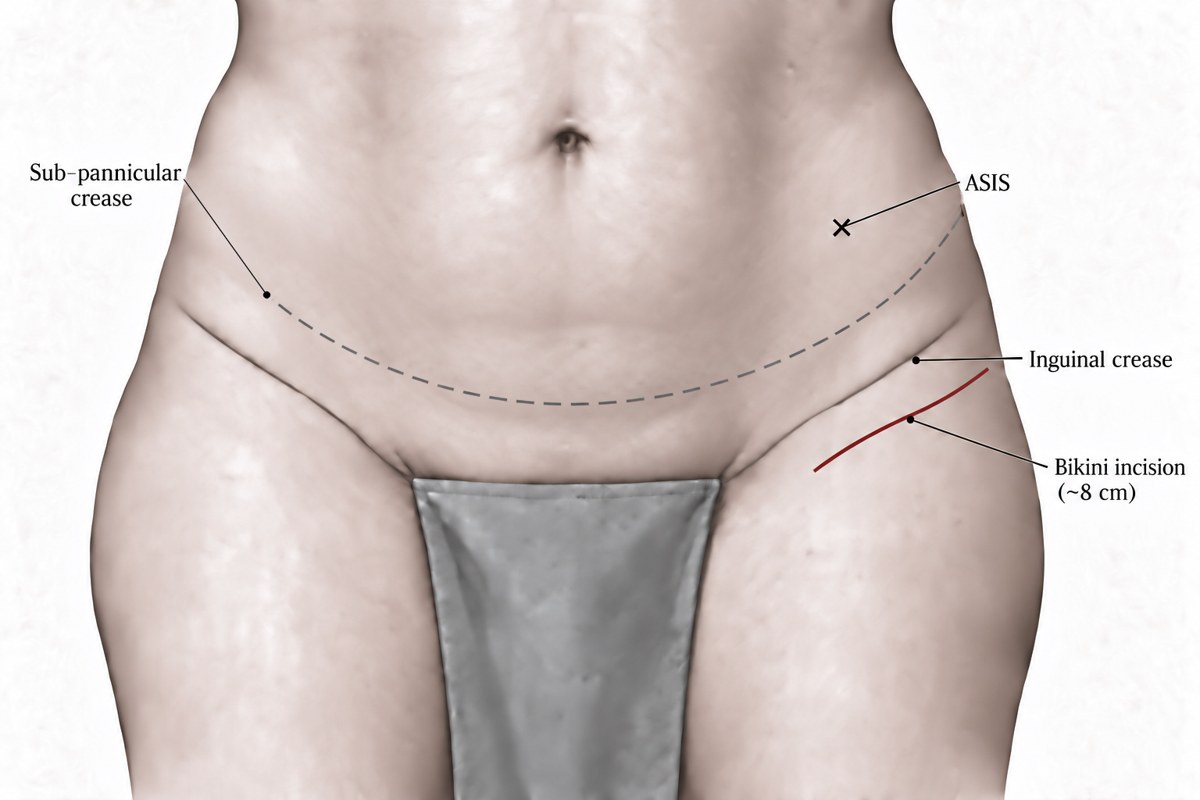
It is on the front of the hip and typically about 8-12 cm long. A bikini-line version, which Dr. Cooper uses the majority of the time, is described below.
What is the bikini incision?
The bikini incision is a short cut, about 8-12 cm depending on body habitus, that follows the natural skin crease at the front of the hip. The traditional incision for the direct anterior approach runs in a straight line along the length of the thigh bone.
The skin at the front of the hip is under tension that runs side to side, and a straight incision cuts across those lines. It has to be closed under more tension, which can contribute to wound healing problems, especially in patients with a higher body mass index. The bikini incision runs along the lines of the groin, so it closes under less tension and is expected to leave a narrower, more cosmetically favorable scar with a lower chance of the top layer of the wound separating.
There are trade-offs. The bikini incision is less easy to extend if more exposure is needed, so is best performed by experienced anterior hip surgeons where there is less risk of surgical complications. Dr. Cooper has published studies finding it safe and effective for direct anterior hip replacement. Whether it is the right choice for you depends on your anatomy and skin creases, and he will go over it with you.
How long will I stay in the hospital?
Dr. Cooper's patients go home either the same day as surgery or the next morning, depending on the patient and the plan made beforehand.
A stay in a rehabilitation facility or nursing home after hospital discharge is strongly discouraged, to avoid a higher risk of postoperative complications. It is rarely recommended, and only for elderly, frail patients who do not have a support system at home.
Can the anterior approach be used for revision surgery?
In experienced hands it is used for some revisions. Whether it suits a given revision depends on why the first replacement is being redone and on the implants already in place. Dr. Cooper performs nearly all primary and the large majority of his revision hip replacements through the direct anterior approach.
What should I bring to my first visit?
Bring any X-rays, MRI or CT images or reports, a list of your medications, and records of previous surgery on the hip or leg.
Schedule a surgical consultation
Offices are in Midtown, Uptown and Westchester. See locations.
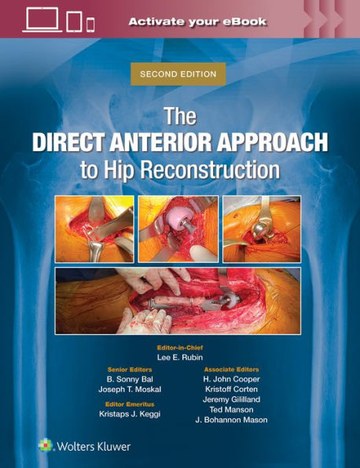 Textbook
The Direct Anterior Approach to Hip Reconstruction, Second Edition
Dr. Cooper is an Associate Editor. View the book on Amazon.